Amateur sleuth identifies those dying as 'John Does'
'Everyone deserves a name' is truth seeker's creed
February 21, 2006
The Tennessean
By LEON ALLIGOOD Staff Writer
LIVINGSTON, Tenn.
Todd Matthews' work as an amateur sleuth begins with a body, a corpse with no name who has suffered the indignity of dying, often by violence, without a form of identification.
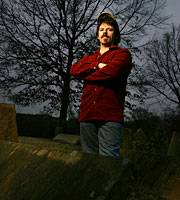
Todd Matthews of Livingston, Tenn., spent 10 years trying to determine one body's identity.
These unidentified John and Jane Does ? there are currently 43 in Tennessee, according to law- enforcement authorities ? are often buried in unmarked pauper's graves, easily forgotten because law-enforcement agencies do not have the resources to keep looking for a name to match the body.
But Matthews takes the time.
The 35-year-old man, whose day job is being a quality control inspector at a company that makes parts for auto air conditioners, loves a good mystery, but not the kind that neatly unravels with the reading of a whodunit. Putting a name to unknown faces ? "they're all someone's mother or daughter, father or son" ? is a riddle that often takes years, decades, to solve.
"It helps if you're obsessive about this,'' declared Matthews, 35, a mustachioed man with a head of wiry dark hair usually hidden beneath a baseball cap.
It also helps if you have a small army of likeminded individuals to call on for assistance. In this army, Matthews is a ranking officer. In 1998, he helped found The Doe Network, an Internet coalition of people around the world whose mission is to unearth the names of unidentified decedents in their areas. There are now representatives in 22 foreign countries, as well as members in all 50 states.
Their primary tool is the Information Superhighway. The Doe Network stands where Internet technology meets dogged, key-stroking persistence. No trail is too obscure, no clue too tangential, no amount of e-mailing excessive in search of the leanest of facts.
The Doe Network has been credited with discovering the identities of 34 no-name bodies since it organized. That might not sound like many, but considering Doe members operate without pay on their own time, often without the direct help of law enforcement, and that many of the "unknowns" had been dead for years, their success rate is a source of enormous pride for members.
Tom Bodkin, who works at the Hamilton County medical examiner's office in Chattanooga, says Doe members' work is vital.
"The point is that they are checking out possible matches. Everyone we rule out is one less we have to go to later," said Bodkin, a forensic anthropologist who has two Doe case files awaiting the discovery of names. "It's an uphill battle. For these people to be searching through a haystack to find the needle is a great service. They pick up where law enforcement leaves off."
Matthews acknowledges that his work is "akin to grasping at straws.
"You just hope to pull out one piece of information that leads to a more crucial piece,'' he said, sitting at his cluttered computer desk in the living room of his otherwise tidy home that overlooks his hometown of Livingston from a rise known as Short Hill.
Here, late on a night in 1998, he broke his first case, a puzzler that had confounded him for more than a decade. The Jane Doe whose identity he sought had been known simply as Tent Girl. In 1968, her body, wrapped in a canvas tarpaulin, was found near Georgetown, Ky.
The man who discovered the remains was Wilber Riddle, Matthews' father-in-law. Matthews married Lori Riddle in 1988 after both graduated from Livingston Academy.
"It was one of the first things we talked about when I started dating Lori,'' said Matthews, who recalled that his father-in-law was always quick to retrieve a wrinkled magazine article about the Tent Girl from his wallet.
"For some reason, the story of the Tent Girl got inside of me and I couldn't let go. It changed my life. A whole new adventure for me actually began."
For hours on end, Matthews sat at the computer screen, Web-surfing late into the night. "The Tent Girl became an obsession. I was on a self-destructive path with her,'' he said, noting that his marriage suffered.
"There was this other woman in my life. Lori wanted to have faith I could identify the woman, but she felt like it was drawing too much of me away,'' he said.
The night in 1998 when he connected Tent Girl to a Lexington, Ky., woman who had been missing since 1967, Matthews was browsing on a hunch. A message on a genealogical Web site attracted his attention.
"My sister Barbara has been missing from our family since the latter part of 1967. She has brown hair, brown eyes, is around five feet, two inches tall, and was last seen in the Lexington, Ky., area,'' read the posting.
The e-mail was from Rosemary Westbrook from Benton, Ark., who was seeking information about her sister, Barbara Taylor. Matthews shakily typed a reply message: "This girl is my girl."
Westbrook thought so, too. The family persuaded Kentucky authorities to allow an exhumation, and a DNA comparison made it certain: Tent Girl was Barbara Taylor.
"I thought there would be a story in the local newspaper and that would be the end of it. It wasn't,'' Matthews said. What followed was a media storm of attention as national television news shows found their way to Livingston. A book deal with a New York publisher is pending, and a documentary is being filmed now.
His work with The Doe Network led him to create Project EDAN, which stands for "everyone deserves a name." EDAN links artists with police departments that don't have an artist on staff. They provide sketches and, sometimes, sculpted models of what the John or Jane Doe may have looked like.
"Until two weeks ago I had a human head here that we reconstructed," Matthews said. "It's from Campbell County. The detective, quite bluntly, gave me a head in a duffel bag. One of our artists did the reconstruction.''
In his hometown, Matthews went from being "that crazy guy interested in something icky" to "the eccentric, but interesting, guy."
He says he regrets that his search for clues caused him to ignore his wife and two boys at times, but calls the identification of Tent Girl "a life-fulfilling moment."
"I spent 10 years of my life searching for Tent Girl's name. I could have gotten a college degree and an advanced degree in that time, but she taught me a lot more still is."
http://www.tennessean.com/apps/pbcs.dll/ar...10338/1017/NEWS